
Edge Computing Based Multi-Objective Task Scheduling Strategy for UAV with Limited Airborne Resources
Abstract
Due to the limited onboard resources of unmanned aerial vehicle, it often leads to insufficient computing power, resulting in task delays under heavy tasks. To solve this problem, a system model based on edge computing is studied and constructed, which involves task allocation center, unmanned aerial vehicle group, data node and power supply station. A mathematical optimization framework based on task, resource and scheduling models is proposed, and the algorithm III of non-dominated sorting inheritance algorithm is used. The objective optimization was efficiently processed through genetic operations, non-dominated sorting, and reference point based selection mechanisms. These results confirm that the non-dominated sorting genetic algorithm III performs well in comprehensive performance evaluation, with an MS index of 0.881 in large-scale map tests and an AQ index of 0.133 in medium-sized maps. In terms of calculation time, in small, medium, and large map tests, the calculation time is 58.9 seconds, 140.5 seconds for medium, and 545.3 seconds for large, respectively, leading other algorithms. Therefore, the designed model has excellent performance in task quality, time extension, and computational efficiency, and has application value.References
DOI:
https://doi.org/10.31449/inf.v48i2.5885Downloads
Published
05/28/2024
Issue
Section
Regular papers
License
Authors retain copyright in their work. By submitting to and publishing with Informatica, authors grant the publisher (Slovene Society Informatika) the non-exclusive right to publish, reproduce, and distribute the article and to identify itself as the original publisher.
All articles are published under the Creative Commons Attribution license CC BY 3.0. Under this license, others may share and adapt the work for any purpose, provided appropriate credit is given and changes (if any) are indicated.
Authors may deposit and share the submitted version, accepted manuscript, and published version, provided the original publication in Informatica is properly cited.
How to Cite
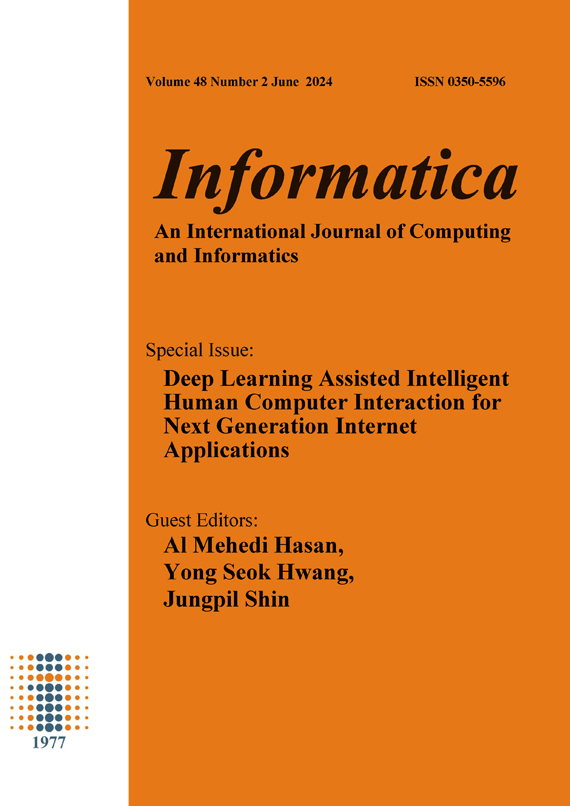
Wang, X. (2024). Edge Computing Based Multi-Objective Task Scheduling Strategy for UAV with Limited Airborne Resources. Informatica, 48(2). https://doi.org/10.31449/inf.v48i2.5885






